Miguel Álvarez Ortega, University of Seville, Kyoto University
The legal history of Bhutan presents a distinctive paradox. On the one hand, Bhutanese institutions and scholarship consistently portray the country’s legal system as the product of a long and largely uninterrupted tradition, stretching from its seventeenth-century foundations to the present constitutional order. On the other hand, much of what would conventionally be described as “law”—particularly in the domain of private relations—was historically unwritten, customary and locally administered. Moreover, law and political power are locally described within an ongoing narrative of Buddhist legitimation and ethics, while the extent of its substantive connection with the modern legal framework is a matter of discussion (Álvarez Ortega). This combination of strong narratives of continuity and a fragmentary documentary record makes Bhutan’s legal past both compelling and difficult to reconstruct.
Customary Law and the Limits of Written Sources
A key challenge in studying Bhutanese legal history lies in the enduring importance of customary and informal legal practices. Matters such as land use, inheritance, family relations and local dispute resolution—areas typically associated with private law—were traditionally governed through oral norms embedded in village life rather than through written legal instruments. These practices were mediated by local authorities and community consensus, leaving limited archival records.
This reality has long been acknowledged within Bhutan itself. Reflections by leading Bhutanese jurists, including former Chief Justice and constitutional drafter Sonam Tobgye, have repeatedly emphasised that formal codification represents only one layer of Bhutan’s legal order, coexisting with deeply rooted informal and customary mechanisms of justice. More recently, socio-legal research has examined these dynamics empirically. Stephan Sonnenberg’s detailed study of dispute resolution in Bhutan, for instance, documents the continued vitality of informal procedures at the community level and explores the tensions generated by their gradual formalisation within the modern legal system. Recent initiatives, such as Michaela Windischgraetz’s ongoing visual and scholarly project on local mores and legal memory explicitly acknowledge the central role of customary law in shaping legal consciousness and everyday justice in Bhutan. Together, these perspectives highlight a fundamental point: much of Bhutanese legal life historically unfolded outside written law, complicating attempts to reconstruct it through texts alone.
Foundational Narratives and the Zhabdrung
Despite these limitations, Bhutanese legal history is commonly framed through a generative foundational narrative centred on Zhabdrung Ngawang Namgyal (1594–1651). A Tibetan Buddhist master who migrated from Ralung, the Zhabdrung is credited with unifying the region and establishing Bhutan as a polity governed through a distinctive dual system (chos srid) of authority (Deleplanque). In Bhutanese political memory, he is not only the founder of the state but also its primordial lawgiver, occupying a quasi-mythical position at the origin of Bhutan’s legal order.
This foundational role is reflected in several normative instruments attributed to him. These include a monastic code (bca’ yig, 1614) (Imaeda), regulations of etiquette later known as driglam namzha (Aris), and a general legal framework commonly referred as the “Black-Slate Edict of Punakha Dzong” (mid 17th c.).
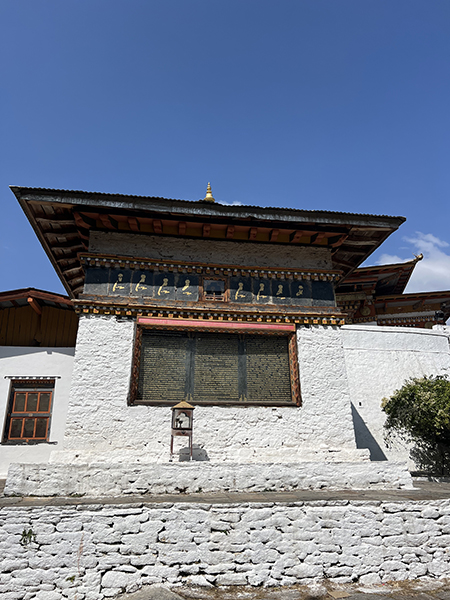
Recent scholarship has significantly advanced our understanding of this early legal framework. Namely, the 2019 translation and study by Michaela Windischgraetz and Rinzin Wangdi of the Punakha Edict represents a milestone. Widely regarded as Bhutan’s earliest general legal instrument, the text is primarily administrative in nature, regulating offices, taxation, judicial procedures, and the duties of officials and commoners alike.
Although the precise contours and mutual relationships of these instruments remain debated, they collectively articulate a vision of law grounded in Buddhist ethics, administrative order, and the coordination of religious and secular authority.
Buddhist Concepts and the Dual System of Government
What is particularly striking in this early legal material is the explicit embedding of law within a Buddhist conceptual universe. Law is presented as a “Golden Yoke” (gser gyi gnya’ shing), a normative order intended to benefit sentient beings rather than merely to enforce obedience. The legal system is articulated through the ideal of the ‘Dual System of Government’, expressed in formulations such as lugs gnyis kyi bstan srid and chos srid, which designate the coordinated governance of religious and lay spheres.
Within this framework, the lawgiver is explicitly associated with the figure of the chos rgyal, or Dharma King—a model of righteous rule traditionally linked to Songtsen Gampo, the paradigmatic Buddhist ruler of Tibet. References to the five Buddhist precepts and the sixteen pure rules of conduct further underscore the idea that law, morality and political authority were conceived as inseparable. In this sense, early Bhutanese law was not simply a mechanism of governance, but an ethical project rooted in Buddhist kingship.
Tibetan Influences and Local Adaptation
Bhutan’s early legal culture did not emerge in isolation. The Zhabdrung himself came from Tibet, and Bhutanese legal codes show clear affinities with Tibetan administrative and legal traditions, including the zhal lce codes associated with the Tsang rulers and the Dalai Lamas. Parallels in structure, terminology and ideology—particularly the emphasis on Buddhist kingship and administrative hierarchy—situate Bhutan within a broader Tibetan legal and political world.
At the same time, the precise processes through which these Tibetan models were adapted to local Bhutanese conditions remain insufficiently studied. While scholars have identified textual parallels with Tibetan imperial and post-imperial legal materials, much less is known about how such norms were implemented, modified or resisted at the local level, especially in interaction with entrenched customary practices. The relationship between imported legal ideas and indigenous social norms thus remains one of the most important open questions in Bhutanese legal history.
Re-Promulgation Rather Than Rupture
In addition to the mid-seventeenth-century Punakha Edict attributed to the Zhabdrung, the only other pre-modern general legal instrument is the legal decree of 1729. The decree was commissioned by the tenth Druk Desi Mipham Wangpo and associated with Desi Sangye Gyatso´s Guidelines for Government Officials (1681; Cüppers), which reinforces an impression of continuity rather than innovation. Preserved within a broader historical chronicle and translated by Michael Aris and later by Karma Ura and Jigme Thinley, this code largely reiterates earlier principles while expanding administrative detail.
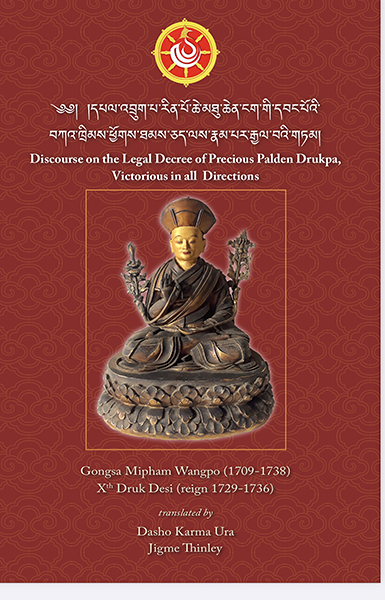
Its structure—combining Buddhist ideology, duties of rulers and officials, monastic discipline, taxation, military organisation and dispute resolution—suggests a process of re-promulgation and clarification rather than legal rupture. Bhutanese historical sources themselves emphasise that the code drew on earlier materials, some of which have yet to be identified or have been lost, further reinforcing the narrative of an enduring legal lineage originating with the Zhabdrung.
Modern Transitions and the Idea of Continuity
From an external perspective, Bhutan’s political transformations in the twentieth and twenty-first centuries might appear to mark sharp legal breaks. The establishment of a hereditary monarchy in 1907 and the transition to a democratic constitutional monarchy in 2008 could easily be interpreted as moments of discontinuity.
Yet within Bhutan, these developments are rarely framed in such terms. Official discourse and much local scholarship emphasise gradual adaptation within a continuous normative framework rooted in Buddhist values and foundational legal principles (e.g., Lungten Dubgyur; Sonam Kinga). Even features that might appear discontinuous—such as the absence of monastic representatives in the contemporary legislature—are not typically presented as a rejection of the dual system, but as contextual adjustments compatible with its underlying ethos.
This perspective is further reinforced by references to the Thrimzhung Chenmo (1953–1959), often described as Bhutan’s first comprehensive codified law. While this code clearly marks the beginning of a modern legal era, it is commonly portrayed not as a new beginning, but as the formal consolidation of long-standing legal ideas into a unified textual framework. However, scholars like R. Whitecross make the case of this corpus rather being Anglo-Indian law “buddhicized” for legitimacy purposes.
Law as Memory and Practice
Ultimately, the legal history of Bhutan cannot be understood solely through surviving texts. It is a history shaped equally by memory, practice and narrative. Written codes provided symbolic foundations and administrative structure, while customary law governed everyday life. The persistent emphasis on continuity—despite political transformation and legal modernisation—reveals a distinctive legal self-understanding in which legitimacy derives less from textual completeness than from moral coherence and historical depth.
For scholars, this presents both a challenge and an opportunity. Much archival and ethnographic work remains to be done, particularly on the local adaptation of Tibetan legal models and the operation of customary law. At the same time, Bhutan offers a reminder that legal history is not only about what was written down, but also about how law was lived, remembered and justified across generations.

Miguel Álvarez Ortega is a professor at the University of Seville of Philosophy of Law with a background in translation studies, Buddhist Philosophy and Classical Tibetan. He specializes in Buddhism and Law, with a focus on the Himalayas.